Whatever Happened to Penny Candy? The Real Story of Why It Disappeared From America’s Corner Stores
Whatever Happened to Penny Candy? The Real Story of Why It Disappeared From America’s Corner Stores
If you’re reading this, you’ve probably asked yourself the question at least once. Maybe you were standing in a movie theater, picking through their meager candy selection, and thought: “Whatever happened to penny candy?” Or perhaps you were explaining to your own children what it meant to walk to the corner store with a quarter in your pocket and walk out with a paper sack overflowing with sweets. Here at Nostalgic Eats, we’ve spent years documenting exactly why these memories run so deep — and the answer is more complex and more poignant than simple inflation. It’s a story about how America transformed, how our retail landscape shifted beneath our feet, and how economic forces disrupted one of childhood’s most democratic traditions.
Penny candy didn’t vanish overnight. It was displaced. It was replaced. It was economically priced out of existence. And understanding what happened to penny candy is understanding what happened to America itself between 1960 and 2000.
Part One: The Golden Era (1950s–Early 1970s)
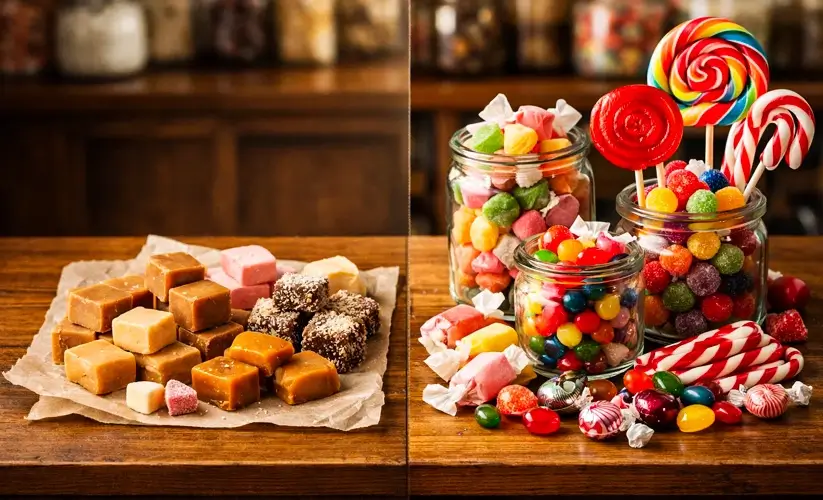
To understand what was lost, we need to understand what we had. The 1950s through early 1970s represented the peak of penny candy culture. If you want a vivid picture of what penny candy from the 50s actually looked and felt like, the variety and accessibility of that era is almost hard to believe today. A child with a penny — literally one cent — could purchase a genuine piece of candy. With a nickel (five cents), you could be wealthy. A dime opened up possibilities. A quarter felt like winning the lottery.
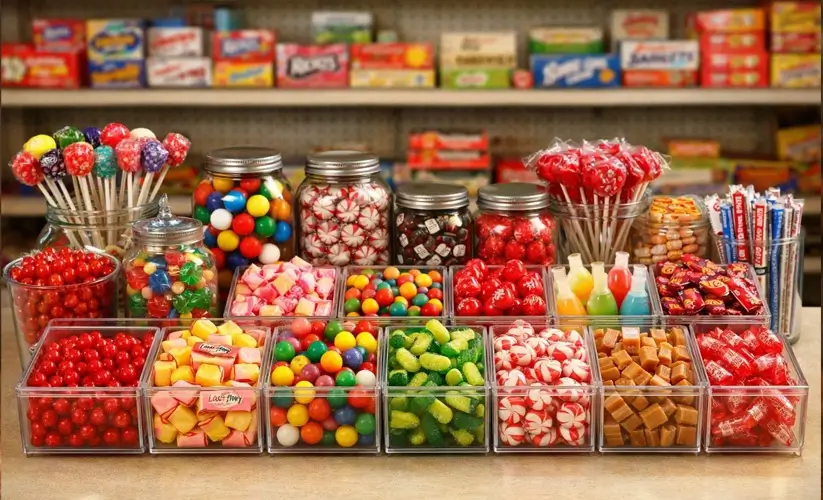
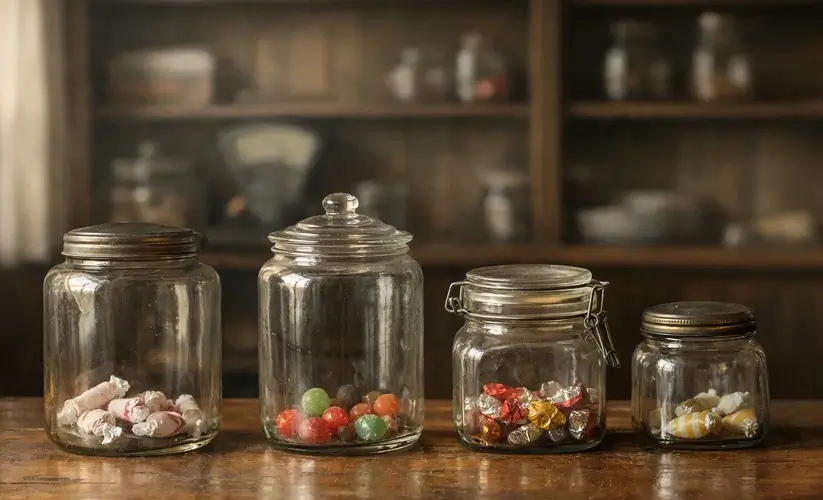
The economics were simple: candy manufacturers operated on razor-thin margins, supermarket-bound supply chains didn’t yet dominate retail, and independent corner stores existed on nearly every block in every neighborhood. These weren’t elegant boutiques. They were bare-bones operations — a counter, some shelves, and behind the register, a collection of glass jars filled with colorful sweets. The jar wasn’t just decoration; it was democracy. Any kid with any amount of money could participate. A penny bought a piece of licorice. Two cents bought a lollipop. Five cents could secure a small bag of mixed assortment.
This system worked because the margins were absurdly thin, but the volume was enormous. A corner store might stock 15–20 different penny candies, with dozens of pieces in each jar. Transaction volume compensated for razor-thin per-item profit. The corner storekeeper knew every kid in the neighborhood by name. Regular customers built loyalty. The social fabric of the neighborhood wove through that candy jar.
Part Two: The First Crisis — Inflation and the 1970s
The 1970s arrived with economic turbulence. The Vietnam War had drained government coffers. OPEC’s oil embargo created an energy crisis. Stagflation — the toxic combination of stagnation and inflation — strangled the economy. Sugar prices, in particular, experienced dramatic volatility.
In 1970, sugar traded at approximately $0.60 per pound (in real dollars, about $3.00 in today’s money). By 1975, sugar prices had quadrupled. Global sugar supplies tightened. Weather disruptions affected crops. Speculation drove futures prices higher. What this meant for penny candy was simple: the economics of the per-penny candy broke down.
Manufacturers faced a choice: compress the size of candies, raise prices, or exit the penny candy market. Most chose a combination. Tootsie Rolls became slightly smaller. Lollipops shrank. Taffy got thinner. And prices crept upward. What cost a penny in 1970 cost three cents in 1975 and a nickel by 1980.
For kids and corner store owners, this felt like betrayal. The term “penny candy” became increasingly absurd. By the late 1970s, what had once cost a penny now cost 10–15 cents. The fundamental economics — the idea that a single penny could access a piece of candy — evaporated.
Inflation didn’t just raise prices; it destroyed a category. When the minimum purchase price for “cheap candy” becomes 10 cents instead of 1 cent, you’ve effectively created a new market tier. And that new tier required different retail structures.
Part Three: The Retail Revolution — The Death of the Corner Store
While inflation squeezed margins from above, a retail revolution was eroding the corner store from below. The supermarket age had begun in the 1960s, but it accelerated dramatically through the 1970s and 1980s.
Supermarkets operated on an entirely different economic model. They offered:
Economies of scale: Supermarkets could purchase directly from manufacturers in massive volumes, negotiating prices per unit that independent corner stores couldn’t access. A supermarket buying 100,000 lollipops paid less per unit than a corner store buying 500. This allowed supermarkets to underprice corner stores on almost every item.
Convenience: Supermarkets offered one-stop shopping. Why visit the corner store for milk, bread, and candy, then the butcher, then the pharmacy? Supermarkets consolidated everything under one roof. For busy suburban families, this was revolutionary.
Loss-leader pricing: Supermarkets could afford to sell candy at thin margins because they made up profit through volume and cross-purchasing. A customer buying discounted candy might also purchase higher-margin items.
Parking and car culture: Federal highway spending and suburban development fundamentally rewrote American geography. The car became the primary shopping vehicle. Suburban supermarkets with expansive parking lots became the destination. Dense urban neighborhoods — where corner stores thrived — suddenly seemed inefficient for car-dependent shoppers.
The result: between 1970 and 1995, tens of thousands of independent corner stores closed. They were replaced by convenience store chains (7-Eleven, Circle K, convenience store franchises) and supermarket candy aisles. The small, locally owned business model that had sustained penny candy culture simply couldn’t compete.
Part Four: Retail Consolidation — The Branding of Candy
As independent retailers disappeared, the remaining retail space was consolidated into fewer, larger players. And these players had fundamentally different interests than corner store owners.
Supermarkets and convenience chains preferred branded, pre-packaged candy. Why? Several reasons:
Labor efficiency: A pre-packaged Skittles display required one employee to stock it. A bulk candy jar required periodic restocking, constant monitoring for freshness, careful inventory tracking, and customer interaction. Pre-packaged was cheaper to maintain.
Standardized margins: Manufacturers’ suggested retail prices ensured predictable profit margins. A jar of mixed penny candy assortments offered no such clarity — which is part of what made them so special to begin with.
Brand loyalty: Supermarket managers knew that customers had loyalty to brands like Nestlé, Mars, and Hershey. Unbranded bulk candy created no brand recognition and no repeat-purchase loyalty.
Supply chain efficiency: Pre-packaged candy arrived in standardized boxes with universal shelf-space requirements. Bulk candy required custom displays, custom sizing, and logistical complexity.
The shift was subtle but devastating. Between 1980 and 2000, the penny candy jar disappeared from most American retail. Supermarket candy sections replaced bulk offerings with rows of pre-packaged, branded items. A child no longer approached a glass jar and made personalized choices. Instead, they faced rows of name-brand boxes with fixed quantities and prices. The choice wasn’t “How many licorice sticks can I afford?” but rather “Do I buy Skittles or Starburst?”
This represented the corporatization of childhood joy. Candy became a branded commodity, not a democratic accessible treat.
Part Five: The Economics of Absence — Why Penny Candy Never Came Back
By the 1990s, penny candy was gone. And here’s the crucial point: it never truly came back, despite nostalgia. Why? Because the economic conditions that made penny candy viable — thin retail margins offset by massive volume, independent neighborhood retailers, a defined limited category of candy types — no longer existed.
Modern supermarkets and convenience stores could theoretically reintroduce penny candy jars. But they won’t, because:
Real estate costs: Urban real estate, even for corner space, is expensive. A large candy jar occupies 20–30 square feet of valuable shelf space. That same space could stock pre-packaged candy generating 10x the profit margin.
Labor costs: Bulk candy requires constant attention. It spoils. It needs restocking. Modern minimum wages make penny-per-transaction economics impossible.
Insurance and liability: Modern food safety regulations require detailed tracking of bulk candy freshness, allergen labeling, and contamination prevention. The liability exposure for a 99-cent bulk jar is surprisingly high.
Customer expectations: Modern consumers expect packaging, branding, clear ingredient lists, and expiration dates. Unbranded bulk candy feels suspicious to contemporary shoppers.
Profit margins: A supermarket makes 30–40% margin on pre-packaged candy. A penny candy jar, even at modern prices (15–50 cents), generates single-digit percentage margins. The math doesn’t work for modern retail.
The economic conditions that made penny candy viable — simplicity, volume, thin margins, community retail, neighborhood density — no longer exist in America. They can’t be easily recreated without fundamentally restructuring modern retail.
Part Six: The Nostalgia Economy — Penny Candy Today
And yet, penny candy hasn’t completely disappeared. It’s been transformed into a nostalgia product. Vintage candy stores, online retailers, specialty shops, and movie theaters have recreated the penny candy experience. But here’s what’s crucial: it’s now a premium, niche market.
Today, “retro penny candy” costs 25–50 cents per piece and is positioned as a nostalgic luxury, not an affordable democratic treat. A vintage candy store charges $1.50 for what your grandmother could buy for a penny. The experience is similar — the glass jars, the colorful assortment, the choice — but the economics and meaning are completely different.
This represents a peculiar feature of late capitalism: the commodification of nostalgia. Penny candy has become a luxury good positioned as “authentic” and “retro.” It’s marketed to adults seeking to recapture childhood moments, not to children actually shopping with their pocket money. The target market is disposable-income-having adults, not kids with coins.
If you want to bring some of that magic back yourself, our homemade 1950s penny candy recipes are the closest you can get to the real thing in a modern kitchen.
Part Seven: What We Lost — The Bigger Picture
When we ask “Whatever happened to penny candy?” we’re not just asking about economics. We’re asking about the kind of society we’ve become.
Penny candy represented several things that have genuinely disappeared:
Democratic access: A penny — the smallest unit of American currency — could purchase joy. There was no minimum purchase barrier. Poverty didn’t exclude participation. It was genuinely affordable. You can read the full story of how this tradition began in our complete guide to old-fashioned penny candy.
Community retail: The corner store was a social hub. The shopkeeper knew you by name. You built relationships. The transaction was personal, not algorithmic.
Local economics: Money spent at the corner store stayed in the neighborhood. It supported a local business, a local owner, a local employer. The economics were visible and accountable.
Autonomy and choice: Kids made their own decisions. With their own money, they exercised agency over consumption choices. It was a small-scale rehearsal of adult independence.
Simplicity: The business model was simple and sustainable. A corner store owner didn’t need venture capital, complex supply chains, or corporate backing. The barrier to entry was low. This is why immigrant families could build corner stores and build wealth.
All of this has been replaced by convenience, standardization, efficiency, and corporate consolidation. These aren’t evil things. They’ve made candy cheaper in nominal terms and more available. But something genuinely has been lost. The question isn’t whether supermarkets are better or worse — they’re more efficient. The question is what we sacrificed for that efficiency.
Part Eight: Could Penny Candy Return?
Theoretically, yes. Practically, probably not in any meaningful way. A true return to penny candy would require:
- Serious deflation (impossible in modern economies)
- A return to dense neighborhood retail (unlikely given car-dependent infrastructure)
- A rejection of corporate consolidation (politically and economically unlikely)
- Community acceptance of unbranded, minimally packaged food (cultural shift away from current norms)
What could happen is what’s already happening: niche revival. Urban “convenience stores” are returning to some neighborhoods. Small-batch candy makers are creating artisanal versions. Online retailers are successfully marketing “retro candy” to nostalgic consumers. But these are luxury goods, not democratic access points.
There’s also potential in reimagined corner stores serving urban neighborhoods with density and walkability. Some neighborhoods are experiencing a “corner store renaissance” as young people return to urban centers. These modern corner stores sometimes feature vintage candy sections, though typically at modern prices.
Interestingly, this story played out differently in Britain — where penny sweets followed a strikingly similar path. If you’re curious how the two traditions compare, our breakdown of penny sweets vs penny candy reveals just how parallel these histories really were.
FAQ Section
Q: Whatever happened to penny candy?
A: Penny candy disappeared due to four interconnected factors: massive inflation (especially the 1970s–1980s), closure of independent corner stores displaced by supermarkets, corporate retail consolidation favoring pre-packaged branded goods, and dramatic sugar price increases. By the 1990s, the term “penny candy” became economically obsolete.
Q: What was the cost of penny candy in the 1970s?
A: In the early 1970s, penny candy still cost 1–5 cents. By the mid-1970s, prices crept to 10–15 cents due to sugar price inflation. What truly cost a penny in 1950 cost a nickel by 1975 and a quarter by 1990.
Q: Why did corner stores disappear?
A: Supermarket expansion (1960s–1980s), federal highway investment, suburban development, and big-box retailers (Walmart, Target) consolidated purchasing power and displaced neighborhood independent retailers. By 2000, most independent corner stores had vanished.
Q: How did retail consolidation affect penny candy?
A: Consolidated retailers preferred pre-packaged branded candy over bulk jars. This eliminated the personalized, low-price entry experience. Corporate efficiency destroyed the economic viability of penny candy operations.
Q: Is penny candy making a comeback?
A: Modest revival exists through niche retailers, online candy shops, and vintage stores positioning “retro candy” as premium nostalgia products — typically priced at 25–50 cents per piece, not true pennies. Some of these classics, like old-fashioned wax bottle candy, can even be made at home today.
Conclusion: Grieving a Lost Tradition
When you ask “Whatever happened to penny candy?” you’re not just asking a question. You’re expressing a loss. You’re grieving the disappearance of something that felt democratic, accessible, and connected to neighborhood community. And that grief is valid.
Penny candy didn’t disappear because it was a bad business or because children stopped liking sweets. It disappeared because the economic and social conditions that made it viable transformed. Inflation, retail consolidation, suburban sprawl, corporate efficiency, and supply chain optimization all conspired — not maliciously, just inevitably — to render penny candy economically obsolete.
What remains is nostalgia and niche revival. Vintage candy stores let us taste the past, but they can’t recreate the past’s actual accessibility and democracy. That’s gone. What we’ve gained is efficiency, convenience, and lower nominal prices. What we’ve lost is the small-scale human retail experience, the neighborhood anchor store, and the radical democratization of affordable joy.
If you want to see what this world actually looked and felt like, this vintage candy footage brings the era back to life in a way words alone cannot.
Perhaps the real question isn’t “Whatever happened to penny candy?” but rather “Whatever happened to the America that penny candy represented?” The answer to that question might be more complicated — and more important — than economics alone can explain.Whatever Happened to Penny Candy? The Real Story of Why It Disappeared From America’s Corner Stores
If you’re reading this, you’ve probably asked yourself the question at least once. Maybe you were standing in a movie theater, picking through their meager candy selection, and thought: “Whatever happened to penny candy?” Or perhaps you were explaining to your own children what it meant to walk to the corner store with a quarter in your pocket and walk out with a paper sack overflowing with sweets. Here at Nostalgic Eats, we’ve spent years documenting exactly why these memories run so deep — and the answer is more complex and more poignant than simple inflation. It’s a story about how America transformed, how our retail landscape shifted beneath our feet, and how economic forces disrupted one of childhood’s most democratic traditions.
Penny candy didn’t vanish overnight. It was displaced. It was replaced. It was economically priced out of existence. And understanding what happened to penny candy is understanding what happened to America itself between 1960 and 2000.