Easy Homemade Peach Preserves Old-Fashioned Recipe
Why Your Peach Preserves Stay Runny (And Grandma’s Never Did)
I spent three summers making runny peach preserves before I figured out what I was doing wrong. Every jar looked beautiful when I sealed it, but a week later, the “preserves” were just thick peach syrup with floating fruit chunks. I couldn’t understand why grandma’s preserves set up firm and spreadable while mine stayed liquid.
Then my aunt explained the secret: peaches are naturally low in pectin — the kind of old-fashioned preserving wisdom that grandmothers passed down but rarely wrote out clearly. Pectin is the natural substance in fruit that makes preserves gel and set properly. Apples — like the ones in this apple cinnamon coffee cake — and citrus fruits contain plenty of natural pectin, but peaches barely have any. Without added pectin, peach preserves never set—they just stay runny forever.
Grandma solved this by adding lemon juice, which contains natural pectin, and cooking the preserves longer to concentrate the natural pectins that do exist in peaches. The commercial pectin products work too, but the old-fashioned method using just fruit, sugar, and lemon creates superior flavor without additives.
The 3-to-1 ratio is crucial: three cups sugar for every four cups prepared peaches. Less sugar means preserves won’t set. More sugar makes them too sweet and stiff. This exact ratio, combined with proper cooking time and lemon juice, creates perfect peach preserves every single time.
Quick Recipe Reference
Ingredients You’ll Need
Main Ingredients:
- 4 pounds fresh ripe peaches (about 10-12 medium peaches)
- 3 cups granulated sugar
- ¼ cup fresh lemon juice (about 2 lemons)
- 1 tablespoon butter (reduces foam)
Equipment Needed:
- Large heavy-bottomed pot (6-8 quart)
- Water bath canner or large stockpot
- 7 half-pint (8 oz) canning jars with lids and bands
- Jar lifter
- Canning funnel
- Large bowl for ice bath
- Potato masher or fork
- Wooden spoon
- Ladle
Optional Additions:
- 1 teaspoon vanilla extract
- ½ teaspoon almond extract
- 1 teaspoon cinnamon
- ¼ teaspoon nutmeg
- 1 tablespoon bourbon (for adult version)
Understanding Preserves vs Jam vs Jelly
Most people use these terms interchangeably, but they’re actually different products with distinct characteristics. Understanding the difference explains why your recipe might not work if you’re treating preserves like jam.
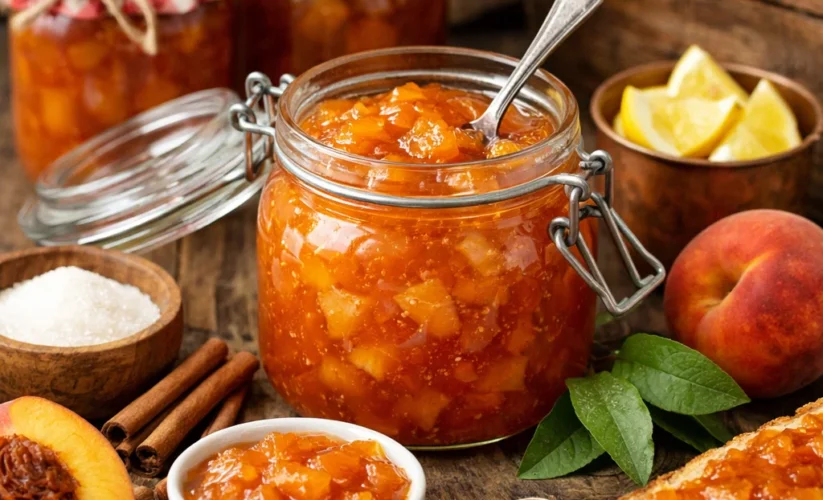
Preserves contain large chunks or whole pieces of fruit suspended in thick syrup. The fruit pieces remain visible and identifiable. Peach preserves should have obvious peach chunks, not mush. The consistency is thick but still spreadable, with a jammy texture around the fruit pieces.
Jam contains crushed or finely chopped fruit cooked until mostly broken down. The fruit loses its original shape and becomes part of the thick spread. Jam has uniform texture without distinct fruit pieces. Most commercial “preserves” are actually jam by traditional definitions.
Jelly contains only fruit juice with no fruit pieces at all. It’s completely smooth and clear, often translucent. Jelly is firm enough to hold its shape but jiggles slightly. Making jelly requires straining out all fruit solids.
Grandma made preserves, not jam, because preserves showcase the fruit itself rather than hiding it in mush. The visible peach chunks prove you used real fruit, not flavorings or fillers. Preserves take slightly more skill because you must cook them gently enough to keep fruit pieces intact while still achieving proper set.
Why Peach Preserves Won’t Set (The Science)
Pectin is a complex carbohydrate naturally present in fruit cell walls. When heated with sugar and acid, pectin molecules form a gel network that traps liquid and creates the set texture we want in preserves. Without sufficient pectin, sugar, or acid, this gel network never forms and preserves stay liquid.
Peaches rank among the lowest-pectin fruits. Ripe peaches contain roughly 0.5% pectin by weight, while high-pectin fruits like apples and rhubarb contain significantly more — the reason this rhubarb pie sets so much easier than any peach recipe. This massive difference explains why apple jelly sets easily while peach preserves struggle.
Lemon juice serves double duty: it provides additional pectin and supplies the acid necessary for pectin to gel. Pectin requires acidic conditions (pH below 3.5) to form proper gel structure. Peaches alone aren’t acidic enough, but adding lemon juice creates perfect conditions.
Sugar concentration matters enormously. Pectin gels properly only when sugar content reaches 60-65% of the final product. This is why the 3:4 sugar-to-fruit ratio is so important. Too little sugar means weak gel that won’t hold. Too much sugar makes preserves stiff and overly sweet.
Cooking temperature and time concentrate natural pectins and evaporate excess water. The mixture must reach 220°F (at sea level) for proper gel formation. At this temperature, sugar concentration is exactly right and pectin molecules have aligned properly.
Understanding these factors means you can troubleshoot problems. Runny preserves? You didn’t cook them long enough or didn’t add enough lemon juice. Too stiff? You overcooked them or used too much sugar. Perfect preserves require balancing all these elements precisely.
How to Make Old-Fashioned Peach Preserves
Step 1: Prepare Peaches
Bring a large pot of water to boiling. Fill a large bowl with ice water. Score an X on the bottom of each peach with a knife.
Drop 3-4 peaches into boiling water for 30-60 seconds until skins loosen. Immediately transfer to ice bath using a slotted spoon. The skins will slip off easily. Repeat with remaining peaches.
Peel, pit, and chop peaches into ½-inch chunks. You need exactly 4 cups of chopped peaches, measured after chopping. Don’t skip measuring—the ratio matters.
Step 2: Prepare Canning Jars
While peaches drain, prepare your canning setup. Wash jars, lids, and bands in hot soapy water. Place jars in water bath canner or large pot filled with water. Bring to a simmer and keep hot until ready to fill.
Place lids in a small saucepan with water. Heat gently (don’t boil) and keep warm until needed. Keep bands at room temperature—they don’t need heating.
Step 3: Combine Fruit and Sugar
In a large, heavy-bottomed pot, combine chopped peaches, sugar, and lemon juice. Stir gently to coat peaches with sugar. Let stand for 15 minutes.
During this maceration period, sugar draws juice from peaches, creating natural syrup. Don’t skip this step—it prevents burning and helps sugar dissolve evenly.
Step 4: Cook Preserves
Place the pot over medium-high heat. Stir gently until sugar dissolves completely, about 5 minutes. Add the tablespoon of butter—it reduces foam formation significantly.
Bring to a full rolling boil that cannot be stirred down. Once boiling hard, reduce heat slightly to maintain steady boil without boiling over.
Cook for 40-50 minutes, stirring frequently to prevent sticking. The preserves are ready when they reach 220°F on a candy thermometer or pass the plate test.
Step 5: Test for Set
The plate test is foolproof. Place a small plate in the freezer at the start of cooking. When you think preserves are done, drop a spoonful onto the cold plate. Return to freezer for 2 minutes.
Run your finger through the preserves. If they wrinkle and don’t immediately run together, they’re done. If still liquid, cook 5 more minutes and test again.
You can also test by spooning up preserves and letting them drip off the spoon. When they sheet off (fall in a sheet rather than individual drops), they’re ready.
Step 6: Fill Jars
Remove jars from hot water and place on a towel-lined counter. Using a ladle and canning funnel, fill each jar leaving ¼-inch headspace at the top.
Run a plastic spatula or bubble remover around the inside of each jar to release trapped air bubbles. Wipe jar rims with a clean, damp cloth to remove any stickiness.
Place warm lids on jars and screw bands on fingertip tight—just until you feel resistance. Don’t overtighten or they won’t seal properly.
Step 7: Process in Water Bath
Using jar lifter, carefully lower filled jars into boiling water bath canner. Water should cover jars by 1-2 inches. Cover canner and return to full boil.
Process half-pint jars for 10 minutes (add 1 minute for each 1,000 feet above sea level). Start timing when water returns to full boil.
After processing, turn off heat and remove canner lid. Let jars sit in hot water for 5 minutes before removing.
Step 8: Cool and Store
Remove jars from canner using jar lifter. Place on a towel-lined counter away from drafts. Don’t disturb them for 12-24 hours.
You’ll hear pings as jars seal—that distinctive pop means vacuum seal formed. After 24 hours, test seals by pressing the center of each lid. If it doesn’t flex, it’s sealed. Unsealed jars must be refrigerated and used within 3 weeks.
Remove bands, wash jars to remove any stickiness, label with contents and date. Store in a cool, dark place for up to 1 year. Refrigerate after opening.
Pro Tips for Perfect Peach Preserves
Use Ripe But Firm Peaches: Overripe mushy peaches make runny preserves. Underripe hard peaches lack flavor. Choose peaches with slight give when pressed gently.
Don’t Reduce Sugar: It’s tempting to cut sugar, but this prevents proper gel formation. The 3:4 ratio is essential for set. Low-sugar recipes require commercial pectin.
Stir Constantly During Final Stages: As preserves thicken, they burn easily. Stir every 2-3 minutes initially, then continuously during the last 10 minutes.
Use a Heavy-Bottomed Pot: Thin pots create hot spots that burn preserves. Heavy stainless steel or enameled cast iron distributes heat evenly.
Don’t Double the Recipe: Making huge batches prevents even heating and proper gel formation. Make multiple small batches instead.
Invest in a Candy Thermometer: The 220°F target takes guesswork out of doneness. Clip-on thermometers are worth every penny.
Add Butter to Reduce Foam: Just 1 tablespoon eliminates most foam, saving you from tedious skimming. This old trick makes preserves clearer and more attractive.
Easy Variations to Try
Bourbon Peach Preserves: Add 2 tablespoons bourbon during the last 5 minutes — the same bold peach-and-savory pairing that makes these pork chops with apples and onions so irresistible.
Vanilla Peach Preserves: Stir in 1 teaspoon vanilla extract when removing from heat for subtle warmth.
Spiced Peach Preserves: Add 1 teaspoon cinnamon and ¼ teaspoon nutmeg — the same warm spice combination that makes this pumpkin pie a fall favorite
Almond Peach Preserves: Add ½ teaspoon almond extract when removing from heat. The almond-peach combination is classic.
Ginger Peach Preserves: Add 2 tablespoons minced fresh ginger with the fruit for spicy-sweet complexity.
Honey Peach Preserves: Replace 1 cup of sugar with 1 cup honey for different sweetness profile and darker color.
Troubleshooting Common Problems
Preserves Too Runny: You didn’t cook them long enough or didn’t use enough lemon juice. Re-cook with additional ¼ cup lemon juice and 1 cup sugar, boiling until proper temperature.
Preserves Too Thick/Stiff: You overcooked them. Next time, remove from heat at 218°F instead of 220°F, or cook for less time.
Fruit Floated to Top: Jars cooled too quickly or fruit was too buoyant. Let preserves cool in the pot for 5 minutes before jarring, stirring occasionally.
Preserves Crystallized: Too much sugar or improper storage. Store in cool location and use within 1 year. Crystallized preserves are still edible.
Jars Didn’t Seal: Headspace was incorrect, rims weren’t clean, or processing time was too short. Refrigerate unsealed jars and use within 3 weeks.
Frequently Asked Questions
Why won’t my peach preserves set?
Peaches are low in natural pectin. You need sufficient lemon juice (provides pectin and acid) and must cook to 220°F. If preserves stay runny, you didn’t cook them long enough or didn’t add enough lemon juice.
What’s the difference between peach preserves and peach jam?
Preserves contain large, visible fruit chunks suspended in thick syrup. Jam is crushed fruit cooked until mostly broken down with uniform texture. Preserves showcase the fruit; jam hides it.
Can I reduce the sugar in peach preserves?
Not without commercial pectin. The 3:4 sugar-to-fruit ratio is necessary for proper gel formation. Low-sugar recipes require special pectin formulated for reduced sugar.
How long do homemade peach preserves last?
Properly canned and sealed preserves last 12-18 months in a cool, dark pantry. After opening, refrigerate and use within 3 weeks. Quality declines after 1 year but they remain safe.
Do I need commercial pectin for peach preserves?
No. Old-fashioned recipes use lemon juice for pectin and longer cooking time. Commercial pectin works faster but isn’t necessary if you follow proper ratios and cooking times.
Can I freeze peach preserves instead of canning?
Yes, though texture may change slightly. Freeze in plastic containers leaving 1-inch headspace for expansion. Freezer preserves last 6-8 months and don’t require water bath processing.
Conclusion
This easy homemade peach preserves recipe proves that old-fashioned methods still produce superior results compared to commercial products or shortcut techniques. Understanding why peaches need extra help to set—their naturally low pectin content—explains why grandma added lemon juice and cooked preserves longer than modern recipes suggest. The precise 3-to-1 sugar ratio, combined with cooking to exactly 220°F and using fresh lemon juice for natural pectin, creates perfectly set preserves with chunky fruit pieces that stay suspended in thick, spreadable syrup. Whether you’re preserving peak-season peaches to enjoy year-round, spreading them on a thick slice of sourdough bread, or creating homemade gifts that actually impress people or simply wanting to taste the difference between real preserves and store-bought jam, this traditional method delivers consistent excellence. Ready to make peach preserves that actually set properly? Blanch those peaches, measure precisely, and discover why generations of Southern grandmothers insisted on making preserves the slow, old-fashioned way — the same grandmothers who perfected this classic sweet potato pie for Sunday dinners. In ninety minutes, you’ll have seven jars of golden peach preserves to enjoy all year — browse our full pies and cobblers collection for more ways to celebrate peak-season fruit that prove homemade still means better—especially when you understand the science behind why preserves set or stay runny forever.